
How Much Should I Spend on Google Ads? A Practical Guide for Service Businesses
If you own a small to mid-sized business in home services, renovations, or construction, chances are you’ve wondered, “How much do Google Ads cost?” or “How do I know if Google Ads is worth the investment?” These are important questions because effective advertising can mean the difference between steady growth and missed opportunities.
In this guide, we’ll walk through the core components of Google Ads costs—including ad spend and management fees—and show you how to figure out the right budget for your business. We’ll also cover how your conversion rate, closing rate, and average sale value all come into play when calculating return on investment (ROI). Finally, we’ll explore why investing in advertising is less risky in the long run than not advertising at all.
Why Google Ads Works for Service Businesses
Service businesses—particularly those in home improvement, renovations, or construction—rely heavily on lead generation to thrive. Unlike selling products online, many of your potential customers will need to speak with someone or see a site visit quote before committing. Google Ads gives you an opportunity to capture people who are actively searching for services like yours. That means:
- High Intent: Prospects searching “roof repair near me” or “kitchen renovation services” are already in need.
- Immediate Visibility: By bidding on relevant keywords, you show up in front of potential customers right when they’re looking.
- Scalability: You can increase or decrease your budget based on how busy you are or how many leads you can handle.
Before diving into the numbers, let’s clarify the two main cost components: ad spend and management fees.
Understanding the Main Cost Components
1. Ad Spend
This is the budget that goes directly to Google when people click on your ads. Think of it as the fuel that keeps your campaigns running. You’ll need enough “fuel” to get a sufficient number of clicks, which can vary based on:
- Keywords: Some terms, like “emergency plumbing,” are more competitive and cost more per click than less urgent ones like “seasonal gutter cleaning.”
- Geographic Location: A busy urban area with lots of competition can drive up costs per click (CPC).
- Timing and Seasonality: For instance, snow removal services might see spikes in CPC during winter months.
2. Management Fee
Most business owners don’t have the time (or desire) to learn every nuance of Google Ads. That’s where management services come in. An experienced agency—like Playbook Digital—charges a fee for creating, optimizing, and analyzing your campaigns. This might be a flat monthly fee or a percentage of your ad spend.
Paying for professional management can actually save you money in the long run. A skilled agency can:
- Optimize Bids: Ensure you’re not overpaying for clicks.
- Improve Ad Quality Scores: Better quality ads often cost less per click.
- Refine Targeting: Show your ads to the right audience at the right time, cutting wasted spend.
- Test Landing Pages: Maximize conversions with continuous tweaks and A/B testing.
Calculating the Right Budget: The Four Key Steps
So, how much should you spend on Google Ads to ensure it’s worth it? Here’s a straightforward way to approach it:
- Identify Your Desired Number of New Clients
Let’s say you want 10 new clients per month. These could be homeowners looking for bathroom renovations or property managers needing HVAC services. - Work Backwards from Closing Rate
If you typically convert 1 out of every 5 leads into a paying customer, that means you need 50 leads (since 50 leads × 20% closing rate = 10 clients). - Estimate Leads Needed from Traffic
Let’s assume your landing page converts 1 out of every 10 clicks into a lead (a 10% conversion rate). That means you need 500 clicks to get 50 leads (500 clicks × 10% = 50 leads). - Determine Cost Per Click and Total Ad Spend
If your relevant keywords average $2 per click, then 500 clicks would cost $1,000 in total ad spend. If keywords are more expensive, say $5 per click, the same traffic would cost $2,500.
From here, you can gauge whether your budget aligns with your revenue goals. You might say, “Okay, I’m happy to spend $1,000 if I can close 10 new clients—each worth $2,000.
That’s $20,000 in revenue for $1,000 in ad spend.” Even after factoring in management fees, the ROI can be significant!
A Quick Example: Kitchen Renovation Leads
Let’s illustrate with a hypothetical, mid-sized renovation company:
- Average Sale Value: $10,000 per project
- Goal: 5 new projects per month ($50,000 in revenue)
- Closing Rate: 25% (1 out of 4 leads becomes a paying client) → Need 20 leads
- Landing Page Conversion Rate: 10% (1 out of 10 clicks becomes a lead) → Need 200 clicks
- Average Cost Per Click (CPC): $4 → Total Ad Spend = 200 × $4 = $800
This company decides to hire a Google Ads management agency with a flat monthly fee of $500. Their total monthly advertising investment is $1,300. In return, they could potentially bring in $50,000 worth of new projects, assuming everything else remains consistent.
Even if results fluctuate, the upside can be substantial compared to the initial spend.
Calculating Your ROI: It’s All in the Numbers
Calculating Your ROI the Easy Way
All you really need to figure out your ROI is:
- Conversion Rate: How many of your ad clicks turn into leads?
- Closing Rate: How many of those leads become paying customers?
- Average Sale Value: How much revenue does each new customer bring in?
Then you use this formula:
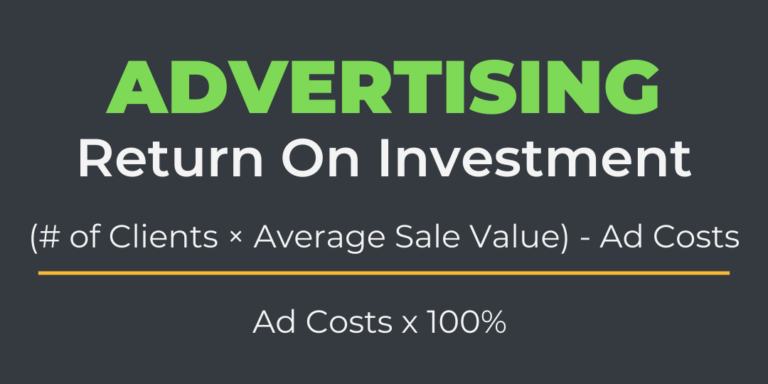
Return On Investment =
(Number of Clients × Average Sale Value)
*Minus* (Ad Spend + Management Fee)
*Divided By* (Ad Spend + Management Fee) x100%
A positive ROI that meets your revenue goals tells you your Google Ads budget is working. If it’s not hitting the mark, it’s a sign you may need to adjust your conversion rate, cost per click, or sales process.
But Isn’t Advertising Expensive?
Here’s the key takeaway: the real expense is missing out on revenue by not advertising. If you’re not generating consistent leads, you’re losing potential customers to competitors who are bidding on keywords like “how much does a bathroom remodel cost” or “emergency HVAC repair near me.”
When you know your numbers—like cost per click, conversion rate, and average sale value—you can make informed decisions about how much to spend. It’s not about blindly throwing money at ads. It’s about investing intelligently to drive quality leads and profitable sales.
Introducing Playbook Digital’s 16-Point Advertising Analysis
At Playbook Digital, we pride ourselves on more than just setting up campaigns. We offer a 16-point advertising analysis that examines each step of your marketing funnel—from keyword selection and ad copy to landing pages and lead follow-up. This process:
Identifies exactly where your current approach might be leaking leads (Is it an unclear landing page? Weak ad copy? Poor follow-up?).
Helps you understand key performance indicators (KPIs) and how to track them.
Provides a clear blueprint for improving ROI, month after month.
Instead of guessing which part of your advertising strategy needs a fix, we pinpoint the pain points so you can invest your budget in the areas that matter most.
Final Thoughts
Running Google Ads is about balancing the right budget with the right strategy. When you align your ad spend, management fee, conversion rates, and average sale value, you gain a clear roadmap to success. The best part? Once you have a winning formula, you can scale your campaigns to capture even more leads and revenue.
Don’t let fear of advertising costs hold you back from connecting with customers who are already out there searching for your services. Instead, focus on knowing your numbers and leveraging the right expertise. Because when done correctly, Google Ads doesn’t just generate leads—it becomes a reliable, measurable engine for your business’s growth.
Ready to Take the Next Step?
If you’re feeling overwhelmed or simply don’t know where to start, don’t worry. That’s exactly why we’re here. At Playbook Digital, we’re committed to helping small and mid-sized businesses get a solid grip on their numbers and make sense of Google Ads—without the high-pressure sales pitch.
Speak with a Playbook Digital Growth Partner to figure out:
How much you should realistically spend on Google Ads.
How to optimize your campaigns for maximum ROI.
Which metrics matter most for your business goals.
We’ll help you build a sustainable advertising plan so that every dollar you spend has a purpose—and a profitable return.
Ready to see how Google Ads can drive growth for your service business?
Book a call with Playbook Digital and let our 16-point advertising analysis guide you toward a profitable, data-driven marketing strategy.
