
Small business marketing in Oakville works best when you set it up in the correct order: local visibility first, reviews and trust second, then paid ads to capture the demand you can’t reach organically yet.
Oakville’s median household income is an estimated $154,901, roughly 50% above the provincial median, so the customers are here and they can pay. The businesses that win are the ones they can find, verify, and contact without friction. This guide covers what to do, what it costs, and how to measure it.
Contents
- What Makes Small Business Marketing in Oakville Different
- Know Exactly Who You Are Marketing To
- Local SEO: Get Found When Oakville Searches
- Social Media: Build Trust, Not Just Followers
- Google Ads: Pay for Demand You Can Measure
- Which Channel First? Local SEO vs. Google Ads vs. Social
- What Should You Budget?
- Measure What Matters
- Frequently Asked Questions
What Makes Small Business Marketing In Oakville Different
Oakville is one of the most affluent markets in Canada. The town’s median household income was an estimated $154,901 in 2025, against a provincial median of $102,116, and nearly 40% of Oakville households earn more than $200,000 a year. More than 85% of working-age residents hold a post-secondary credential.
That cuts two ways. A population of roughly 214,000 with real spending power supports premium pricing for renovations, legal work, clinics, landscaping, and every other local service. But educated, affluent buyers do more homework before they spend, and every competitor from Burlington to Mississauga wants the same customers.
That means generic marketing gets ignored here. In our experience working with Oakville-area businesses, buyers follow a predictable path: search, check reviews, compare two or three websites, then contact one business. If you’re invisible at any step of that path, the job goes to someone else.
Know Exactly Who You Are Marketing To
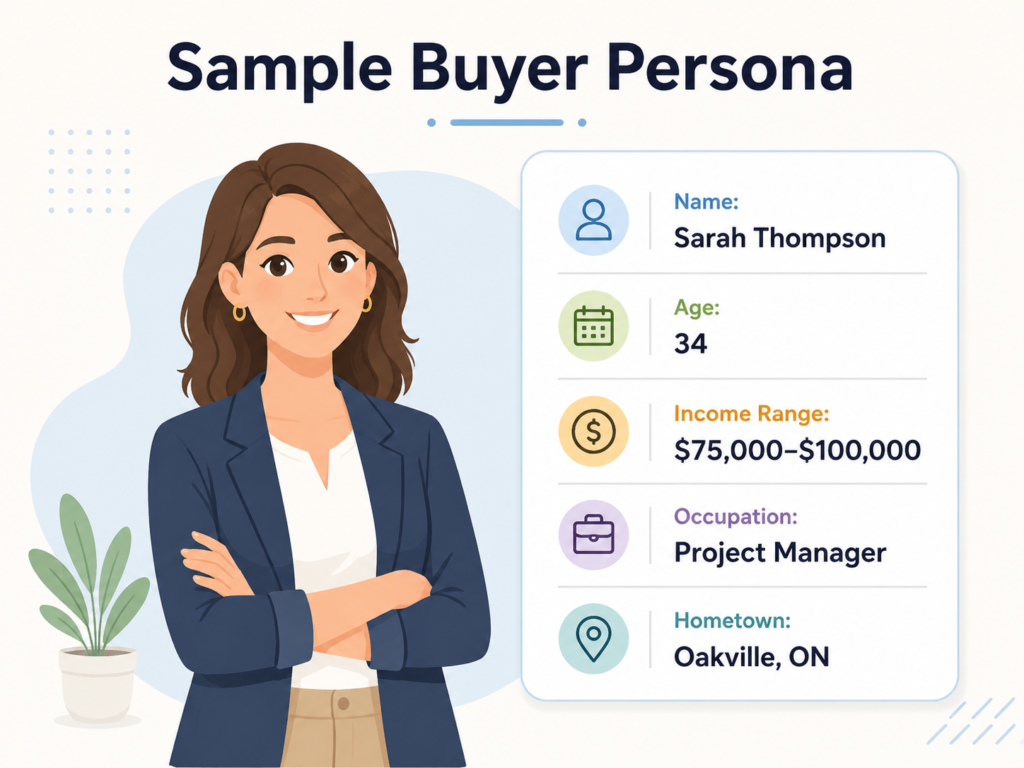
Start by creating detailed buyer personas that represent your ideal customers. These personas should include demographic information such as age, gender, income level, education, and occupation, as well as psychographic details like interests, values, and lifestyle choices. For example, if you run a fitness studio, your target audience might include health-conscious young professionals who value convenience and are willing to invest in premium memberships and personalized training sessions.
Local SEO: Get Found When Oakville Searches
Reviews and visibility are not the same thing. One earns trust. The other determines whether anyone gets the chance to find that out.
We learned this scanning a real Oakville lawn care company: 183 reviews and a 4.8 rating, and it did not appear in a single Google search result across 81 locations in town. Every person who searched “lawn care Oakville” that week was sent to a competitor instead. Great reputation, zero visibility.
The stakes keep rising. BrightLocal’s Local Consumer Review Survey 2026 found that 97% of consumers read reviews for local businesses, and 41% now read reviews every single time they choose one, up from 29% a year earlier. The same study found consumers increasingly filter for businesses rated 4.5 stars or higher.
Where you need to show up is also changing. BrightLocal reports that AI tools like ChatGPT have surged into third place as a source of local business recommendations, behind only Google and Facebook. Being recommended by AI tools is now part of local visibility, which is why we bundle answer engine optimization into our SEO + AEO program.
What to actually do:
- Complete your Google Business Profile: correct categories, services, photos, hours
- Ask for reviews weekly and respond to every one, good or bad
- Build one page per service, written for the towns you serve
- Keep your name, address, and phone number identical everywhere online
If your business has reviews but no rankings, the problem is usually structural. We broke down the most common causes in why local businesses struggle to rank on Google.
Social Media: Build Trust, Not Just Followers
Canada had 33 million active social media user identities as of October 2025, so your customers are certainly on these platforms. But for a local service business, social media rarely generates leads directly. Its real job is verification.
BrightLocal’s data shows how this works in practice: after reading positive reviews, 54% of consumers visit the business’s website and 24% check its social media channels. Social is where a warm prospect confirms you’re real, active, and good at what you do. An account that hasn’t posted since 2024 quietly costs you jobs.
Post proof, not filler. Finished jobs, before-and-afters, a customer review as an image, a two-minute answer to a question you get asked constantly. Two or three posts a week on one platform you can sustain beats daily content on four platforms you’ll abandon by September.
Choose the platform where your best customers already are. Home services and renovations perform well on Facebook and Instagram, where Oakville homeowners actually browse. B2B services belong on LinkedIn.
Google Ads: Pay for Demand You Can Measure
Local SEO compounds, but it takes months. Google Ads is how you show up at the top of the page this week, and pay only when someone clicks.
The results are measurable when the system is built properly. When we rebuilt the Google Ads account for Onboard Drywall, a contractor client, revenue grew 620% at a 447% return on ad spend. Another client, a manufacturing firm, generated $4.6M in attributed revenue over 12 months with 171% more leads at a 53.62% lower cost per conversion. Both case studies are on our case studies page, and both turnarounds started the same way: conversion tracking first, then scaling spend into what the data proved was working.
The rule: never scale spend you can’t measure. In the self-managed accounts we audit, missing conversion tracking and unsupervised broad match keywords are the two most expensive problems, and neither shows up until you go looking.
Budget realistically. For most service businesses near the GTA, $1,500 to $2,500 per month in ad spend is the practical minimum for a campaign to gather enough data to optimize. We published full Ontario benchmarks by industry in our Ontario cost guide. And if you’d rather hand the whole system to someone who does this daily, that’s what our Google Ads management service is built for. If you want the local detail, our Google Ads agency in Oakville page covers how we run paid search in this market specifically.
Which Channel First? Local SEO vs. Google Ads vs. Social
Most small businesses can’t fund every channel at once, and shouldn’t try. Compare what each one actually delivers:
| Channel | Typical monthly cost | Time to first results | Best for | The catch |
|---|---|---|---|---|
| Reviews + Google Business Profile | $0 (your time) | Weeks | Every local business, always first | Needs a consistent ask-and-respond habit |
| Google Ads | $1,500–$3,000 all-in | 2–4 weeks | Leads this quarter, testing demand | Leads stop the day you stop paying |
| Local SEO + AEO | $1,000–$2,000 | 3–6 months | Compounding visibility, lower long-term cost per lead | Slow start, requires patience |
| Social media | $0–$500 (mostly time) | Ongoing | Trust and proof for warm prospects | Rarely generates leads on its own |
The sequencing we recommend:
- First, reviews and Google Business Profile because they’re free and they multiply the return of everything else.
- Then, Google Ads if you need leads now, or local SEO if you’re funding the next three years of growth. Most established businesses eventually run both, since paid fills the gap while organic compounds.
Not sure which order fits your situation? Book a free discovery call and we’ll walk through your numbers with you. No prep needed on your end.
What Should You Budget?
The Business Development Bank of Canada recommends budgeting marketing as a percentage of revenue: 2% to 5% for B2B companies, and 5% to 10% for B2C, which covers most home services and consumer-facing local businesses. A BDC survey of more than 1,400 Canadian businesses found small business marketing costs average just over $30,000 a year.
Applying BDC’s percentages to typical revenue levels:
| Annual revenue | B2B budget (2–5%) | B2C budget (5–10%) |
|---|---|---|
| $500,000 | $10,000 – $25,000/yr | $25,000 – $50,000/yr |
| $1,000,000 | $20,000 – $50,000/yr | $50,000 – $100,000/yr |
| $2,000,000 | $40,000 – $100,000/yr | $100,000 – $200,000/yr |
The percentage matters less than the discipline. A small budget spent on one channel, tracked properly, beats a large budget scattered across five channels with no measurement. In our experience with small business marketing in Oakville and the surrounding GTA, the underperforming accounts are almost never underfunded. They’re unfocused.
Measuring Small Business Marketing: Key Metrics to Track
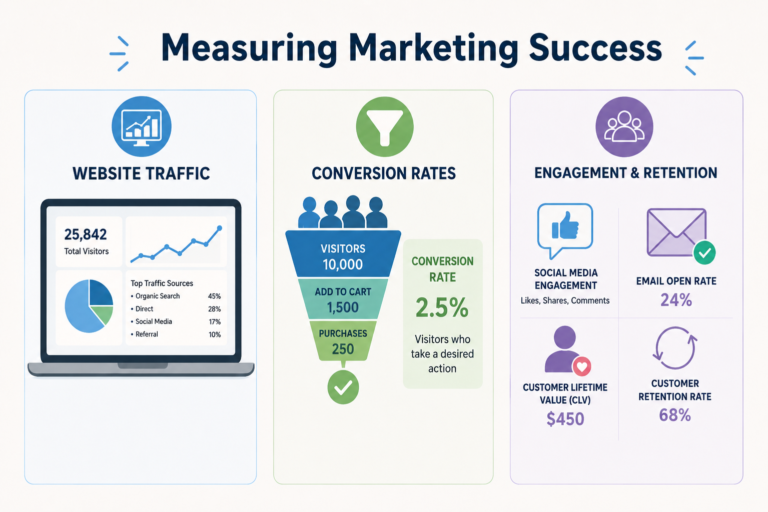
Measuring the success of your marketing efforts is crucial for understanding what works and what doesn’t, and for making data-driven decisions to improve your strategies. There are several key metrics that you should track to evaluate the effectiveness of your marketing campaigns and ensure that you’re achieving your business goals.
One of the most important metrics to track is website traffic. Use tools like Google Analytics to monitor the number of visitors to your website, as well as where they’re coming from and how they’re interacting with your site. This can help you identify which marketing channels are driving the most traffic and which pages are most popular among your visitors. Additionally, track metrics like bounce rate and average session duration to gauge the quality of your website traffic and identify areas for improvement.
Conversion rates are another critical metric to track. This refers to the percentage of visitors who take a desired action on your website, such as making a purchase, filling out a contact form, or signing up for a newsletter. By tracking conversion rates, you can determine how effective your marketing campaigns are at driving desired actions and identify any barriers that may be preventing visitors from converting. For example, if you notice a high drop-off rate on your checkout page, you might need to simplify the process or address any potential issues that are causing friction.
Finally, track metrics related to customer engagement and retention. This includes metrics like social media engagement (likes, shares, comments), email open rates, and customer lifetime value (CLV). These metrics can provide valuable insights into how well you’re connecting with your audience and building long-term relationships with your customers. For example, if you notice a decline in email open rates, you might need to reassess your subject lines and content to ensure that they’re relevant and engaging for your subscribers.
Conclusion: Creating a Sustainable Marketing Plan
Creating a sustainable marketing plan is essential for the long-term success of your small business in Oakville. This involves not only implementing effective marketing strategies but also continuously evaluating and refining your efforts to ensure that they remain relevant and effective in a changing market landscape. By taking a strategic and data-driven approach to marketing, you can build a strong brand presence, attract and retain loyal customers, and achieve sustainable growth.
Start by setting clear, measurable goals for your marketing efforts. These goals should align with your overall business objectives and provide a roadmap for your marketing activities. For example, if your goal is to increase sales by 20% over the next year, you’ll need to develop specific marketing strategies and tactics to achieve this, such as launching a new product line, running targeted advertising campaigns, or enhancing your online presence.
Next, develop a marketing plan that outlines your target audience, key messages, marketing channels, and budget. This plan should be flexible and adaptable, allowing you to make adjustments as needed based on performance data and market conditions. Regularly review and analyze the results of your marketing efforts to identify what’s working and what’s not, and make data-driven decisions to optimize your strategies.
Finally, focus on building strong relationships with your customers and community. This involves providing exceptional customer service, engaging with your audience on social media, and participating in local events and initiatives. By fostering a sense of community and loyalty among your customers, you can create a sustainable competitive advantage and ensure the long-term success of your small business in Oakville.
Frequently Asked Questions
Start with the free foundation. Complete your Google Business Profile and work on getting a steady flow of recent reviews, since 97% of consumers read reviews before choosing a local business.
Then, add Google Ads if you need leads within weeks, or local SEO if you’re building visibility that compounds over years. Most established Oakville businesses eventually run both together.
BDC recommends 2% to 5% of revenue for B2B companies and 5% to 10% for B2C. For a $1M home services business, that’s roughly $50,000 to $100,000 a year across all channels.
Focus matters more than size. One well-tracked channel outperforms five untracked ones.
It depends on your timeline. Google Ads produces leads in two to four weeks but stops the moment you stop paying. Local SEO takes three to six months to move but keeps compounding after that.
If cash flow depends on leads this quarter, start with ads and build SEO in parallel.
Yes, but as a trust channel, not a lead channel. After reading positive reviews, 24% of consumers check a business’s social media to confirm it’s real and active. Two or three proof-of-work posts a week on one platform is enough for most local service businesses.
Expect three to six months before rankings and calls move meaningfully, and longer in competitive categories. Review velocity and Google Business Profile activity tend to move faster than website rankings, which is why we recommend starting the review habit immediately.
Track leads per month by source, cost per lead, lead-to-customer rate, and revenue per channel. If you can’t say where your last ten customers came from, the problem is measurement, not marketing.
Fix tracking first, then judge each channel on cost per lead against what a customer is worth to you.
Yes. We’re based in Oakville and build marketing systems for local service businesses across the GTA and Canada, covering Google Ads, SEO and AEO, websites, and reporting. Book a free discovery call and we’ll show you where your current marketing is leaking leads and what to fix first.
