
Website as a service is simply a managed website subscription. A business pays a provider to design, host, and maintain its site, instead of hiring a developer or building one alone.
Website as a service for small business is becoming the default choice in 2026 because it removes the hiring cycle of an in-house developer, the months-long cycle of a custom build, and the burden of maintaining a site alone.
Contents
- What Is Website as a Service for Small Business?
- Why Most DIY Websites Are Weak
- Why the Subscription Model Is Winning
- Website as a Service vs. DIY vs. In-House Hire vs. Custom Build
- What Website as a Service Doesn’t Solve
- Is Website as a Service Right for Your Business?
- Sources
What Is Website as a Service for Small Business?
Small business website adoption has climbed steadily for years. 83% of small businesses now have a website, up from 64% in 2018, and cost is no longer the main reason the rest don’t. For most owners, the question isn’t whether to have a website anymore. It’s who is responsible for it once it exists.
Website as a service answers is a solution to the headache and investment that comes with owning a website for your company. Instead of investing large amounts of money upfront for a one-off build and owning the responsibility of upkeep, or hiring someone to manage it internally, the business pays a provider on an ongoing basis to design, host, secure, and maintain the site. The relationship is closer to how a business pays for accounting software or a CRM than how it buys a piece of equipment. The business is buying speed, simplicity, and convenience, the same way it buys other services.
Why Most DIY Websites Are Weak
For most small businesses, a website is the last thing on their mind. They started their business because they were good at their craft and their skill allowed them to provide a service, and for years, referrals and word of mouth did the job. Then referrals slow down, or growth stops, and the they decide it’s time to start advertising.
That’s usually the moment the website problem shows up. An owner who has never needed the site to do much more than exist online turns on Google Ads for the first time and sends paid traffic to a page that wasn’t designed to convert visitors into customers.
The same flaw plague the majority of DIY websites. Generic language, thoughtless layout, a weak call to action, no clear offer, slow load times, or a design that hasn’t been touched since the business was founded.
We see this often enough that it shows up in our own numbers. 62% of all clients Playbook Digital worked with between 2025 and 2026 needed some degree of website support from us; copy revisions, conversion rate optimization, new landing pages, or full website builds from scratch. Almost two-thirds of the businesses that came to us for paid media also needed web work, because turning on ads exposed a problem that had been sitting there the whole time.
This is also where a lot of small businesses run into a related problem. Weak landing pages are one of the most common mistakes we see in small business Google Ads accounts. Money spent driving traffic to a page that was never built to hold it is as good as garbage.
Why the Subscription Model Is Winning
It’s easier for the owner
Under a subscription model, the website stops being one more thing the owner has to think about. Content updates, technical questions, and day-to-day upkeep go straight to the provider by default, off the owner’s plate entirely.
It’s faster to stand up
Traditional custom WordPress projects can drag on for months. Time gets spent choosing themes, configuring plugins, setting up hosting, and solving technical problems before the website can even launch.
Website as a Service starts with a proven technical foundation. We focus our time on customizing the design, messaging, and pages around your business not rebuilding the same infrastructure from scratch.
The result is a professional, custom-branded website that can launch in weeks instead of months.
Less maintenance burden
Hosting, security patches, software updates, and uptime monitoring aren’t tasks most owners want to learn, and they don’t stop needing attention once a site is live. Independent maintenance estimates put ongoing upkeep for a small business website at $30 to $300 a month depending on the platform and how much support is included, and that’s before anything actually breaks.
Under a subscription model, that work already sits with the provider as part of the subscription, handled on an ongoing basis instead of something the owner has to remember to buy later.
Cheaper than hiring an in-house developer
The alternative to a subscription or a one-off build is bringing the work in-house, and that math rarely favours a small business. The median wage for a web developer in Canada is $38.46 an hour according to Statistics Canada’s Labour Force Survey data. Annualized to a full-time role, that works out to roughly $80,000 a year before benefits. Salary is also only part of the real number: U.S. Bureau of Labor Statistics data shows wages make up about 70% of total employer compensation costs, with benefits and payroll costs adding the rest on top. A full-time hire is a real fixed commitment for a business that only needs meaningful web work a handful of times a year.
Most owners don’t have the time or expertise
Even businesses that try to handle it themselves run into the same wall. In a May 2025 survey of internet users, 51% of people who started building their own website abandoned the project before finishing it, and 22% never went back to it at all. The obstacle is usually time, not ability. A website builder doesn’t get easier to use just because the business running it is busy.
If you’re weighing whether any of this is worth managing yourself, our breakdown of Google Ads costs in Ontario covers the same trade-off from the paid media side: what it actually costs to do this well versus doing it alone.
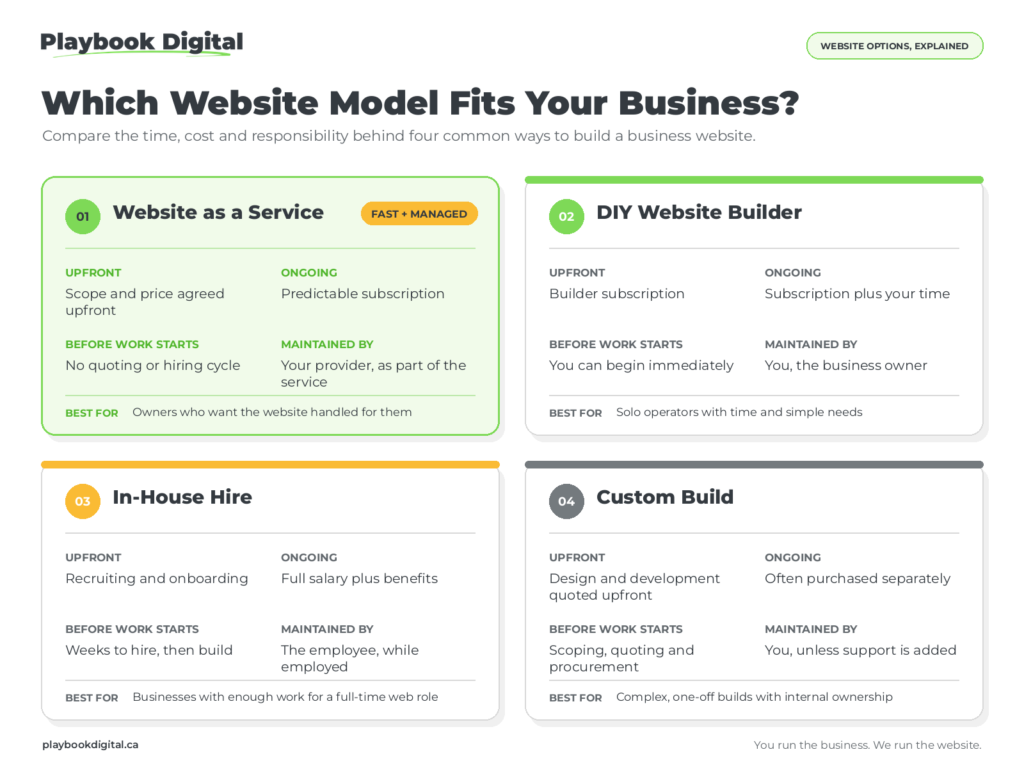
Website as a Service vs. DIY vs. In-House Hire vs. Custom Build
What Website as a Service Doesn’t Solve
A subscription model isn’t a fit for every business. It’s built around continuing to pay for management. The business keeps paying for the site to be designed, hosted, and maintained, and that arrangement continues only as long as the subscription does. A business that specifically wants to buy a finished asset, take it in-house, and never think about the pricing model again is choosing a different kind of relationship than website as a service is built to provide.
It also isn’t the right model at every stage. A business planning a highly custom web application, rather than a marketing website, usually needs a dedicated technical relationship that a general subscription isn’t scoped for.
Is Website as a Service Right for Your Business?
Website as a service for small business isn’t the right fit for every business, but the pattern is consistent for the ones it does fit: an owner who is good at running the business, doesn’t have time to also run a website, and wants the site handled rather than added to their own plate.
Playbook Digital’s own Website as a Service offering is built around that pattern: a website that supports the rest of a business’s marketing, especially Google Ads campaigns that depend on the page behind them actually converting the traffic sent to it.
If you’re getting ready to turn on ads and you’re not sure the website behind them can carry the traffic, book a free discovery call and we’ll tell you honestly where it stands.
Sources
- Clutch — The State of Small Business Websites in 2025
- Job Bank Canada — Wages for Web Developers and Programmers (Statistics Canada Labour Force Survey)
- U.S. Bureau of Labor Statistics — Employer Costs for Employee Compensation, March 2026
- BleylDev — Website Maintenance Cost for Small Business (2026 Guide)
- All About Cookies — Web Builder Statistics 2026
Frequently Asked Questions
Website as a service means a business pays a provider a recurring fee to design, build, host, secure, and maintain its website. Ownership usually stays with the provider, and the business uses the site for as long as the subscription is active. The structure works the way software as a service works for other business tools.
Pricing varies by provider and by how much is included. Playbook Digital’s Website as a Service is $500 to start, then $199 a month plus tax for up to seven pages, on a 12-month minimum term. Playbook Digital owns the website and you license it while the subscription is active. You can buy it outright at any time for a flat $3,000 plus tax. A buyout ends the service, so hosting, security, maintenance, monitoring, and support all stop.
On the question of ownership, that is a fair description: the site stays with the provider. What the fee buys is ongoing work, covering design and build, hosting, security patches, software updates, and monitoring, handled continuously. A business that specifically wants to own a finished site outright is looking for a different arrangement.
Over a long enough period, the total paid can exceed a one-off build price. The monthly fee covers ongoing management: hosting, security, software updates, monitoring, and small content changes. A one-off build leaves all of that for the owner to arrange and pay for separately, so a fair comparison adds a build’s own hosting and maintenance costs on top of its purchase price.
A DIY builder supplies the tools and leaves the work with the business: design, updates, troubleshooting, and content all stay in-house. Website as a service hands that work to a provider. The trade is control and cost against time and expertise, which is why builders suit owners who have time to learn a platform.
The subscription describes how a website is paid for and managed. It says nothing about design quality, which depends entirely on the provider building it. Ask any provider whether the site is built around your business or assembled from a stock layout. For a small business, what matters most is whether the site converts the traffic it receives.
Usually not, where the provider owns the site. Content, images, and lead data generally belong to the business and can be exported, while the built site itself stays with the provider unless a buyout is offered and taken. Whether a buyout exists at all, and what it costs, differs by provider.
Minimum terms are common and often run about a year. Before signing, establish five things: the length of the term, what happens to the site once the subscription ends, whether a buyout is available and at what price, how much notice you get, and whether your domain and email records stay registered in your own name. Get the answers in writing.
Usually not. These subscriptions are scoped around building and running the site itself: hosting, security, software updates, and monitoring. Content production and search optimization are separate ongoing disciplines carrying their own costs, which is why most providers quote them apart from the website subscription and why SEO work is normally its own engagement. Check what is in scope before assuming either is covered.
It tends to fit owners who want the website handled without hiring for it or learning to manage it themselves, especially once they’re ready to advertise and need the page behind the ads to convert. Playbook Digital builds each site around the individual business and manages it from there. If you’re not sure where your current site stands, get in touch and we’ll walk through it with you.
