
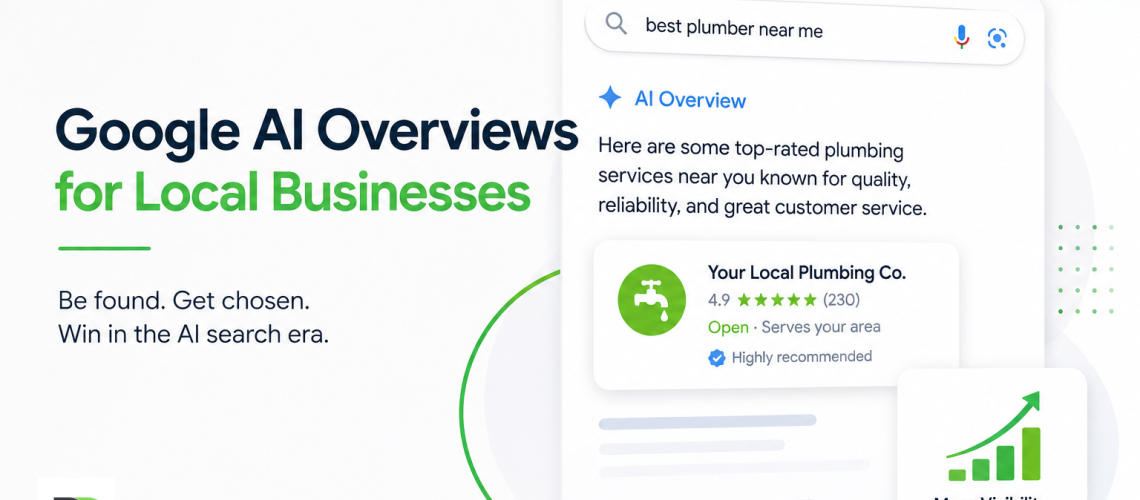
Google AI Overviews are the AI-generated summaries that appear above normal search results. Simple “near me” searches for home services or lawyers still mostly return the map pack, but the informational questions people ask before hiring someone, like cost or timeline, trigger an AI Overview most of the time.
This post will walk through everything you need to know about AI Overviews and how to take advantage of them for your local business.
Contents
- What Are Google AI Overviews?
- Query Intent, Explained Simply
- Which Searches Trigger a Google AI Overview
- What Happens to Clicks When Google AI Overviews Appear
- One Real Test: Category Visibility
- What a Local Service Business Actually Controls
- Should You Worry About AI Overviews Killing Your Leads?
- What to Do About AI Overviews
- Frequently Asked Questions
What Are Google AI Overviews, and Why Do They Matter for Local Search?
Google AI Overviews are the AI-generated explanations that sit at the top of a search results page, bringing together an answer from multiple sources instead of making the searcher click into each one.
Google says the feature can’t be turned off the way older SERP features can. You can filter a search down to text-based links only, but AI Overviews are treated as a permanent layer of results, not a test.
For a local service business, that changes the order of operations. Someone searching “how much does a furnace replacement cost in Mississauga” used to land on a page of business listings. Now they may read a generated summary first, get a rough idea of the cost and a few service provider names, and only click through if the answer doesn’t fully settle the question.
Officially, Google’s own guidance for site owners says there is no separate AI Overview optimization checklist. The advice is the same as standard SEO: keep your site crawlable, link internally, provide a good page experience, make sure important content exists in plain text, and keep structured data matched to what’s actually on the page.
That’s a reasonable baseline, but it says nothing about which searches actually trigger an overview in the first place.
Query Intent: The Types of Questions Searchers Ask
Understanding AI Overviews starts with understanding “query intent,” because intent is the single biggest factor in whether an AI Overview shows up at all.
Searches can be grouped into a handful of intent categories. Here’s what each one means in plain language, using searches a Bronte Creek Plumbing customer might actually type.
Simple local-intent is the “get me a business right now” search. Someone typing “plumber near me” or “Bronte Creek Plumbing phone number” already knows roughly what they want. They’re ready to call or click a listing, not read an explanation.
Informational is a question search. “How long does a water heater last?” or “why is my drain making a gurgling sound?” The person isn’t ready to hire anyone yet. They want an answer first.
Hybrid blends the two: an information need with a strong buying signal attached. “Average cost of a sewer line replacement” tells Google the person wants to understand something and is close to spending money on it. These people are what marketers call “problem aware.”
Reason queries are a specific flavour of informational search built around “why” or “should.” “Should I repair or replace a leaking water heater?” is a reason query. It’s asking for a judgment call, not just a fact.
Commercial queries signal an active purchase decision. “Book a same-day plumber” or “get a quote for drain cleaning” are commercial queries. The person has decided to hire someone and is choosing who. These people are what marketers call “solution aware.”
Navigational queries are searches for a specific business the person already knows about. “Bronte Creek Plumbing hours” or “Bronte Creek Plumbing reviews” are navigational. The destination is already chosen.
None of these categories are random labels. AI Overviews aren’t spread evenly across them. They cluster around informational, hybrid, and reason queries, the ones where Google is answering a question rather than pointing the searcher to a business, and they mostly leave the simple, navigational, “I already know who I want” searches alone. That’s the pattern the data below shows.
Which Searches Trigger a Google AI Overview (and Which Still Favour the Local Pack)
Whitespark ran 540 manual searches across six local-service verticals (plumbers, personal injury lawyers, dentists, optometrists, medical clinics, and real estate agents) in three American cities (Houston, Phoenix, and Denver), and split the results by search intent. Search Engine Land’s guide to AI and local search, written by a contributor to that same study, lays out the pattern with real example queries. Separately, Local Falcon’s whitepaper scanned 60,000 queries across 4,423 businesses in 20 countries using a different intent classification, which is worth keeping distinct rather than blending into the same rows.
| Query type | Example | AI Overview appearance rate | Local pack appearance rate | Source |
|---|---|---|---|---|
| Simple local-intent | “primary care clinic phoenix” | 15% | 90%+ | Whitespark, via Search Engine Land |
| Informational (Whitespark) | “how long does an eye exam take near me?” | 92% | 6% | Whitespark |
| Hybrid (Whitespark) | “average cost of dental implants in phoenix” | 97% | 17% | Whitespark |
| Reason (Local Falcon)* | “should I repair or replace a leaking water heater” | 59.9% | Not reported | Local Falcon whitepaper |
| Informational (Local Falcon)* | “how much does it cost to reline a sewer pipe” | 58.3% | Not reported | Local Falcon whitepaper |
| Commercial (Local Falcon)* | “book a same-day plumber” | 17.2% | Not reported | Local Falcon whitepaper |
| Navigational (Local Falcon)* | “Bronte Creek Plumbing hours” | 10.5% | Not reported | Local Falcon whitepaper |
*Rows marked with an asterisk use illustrative example queries we constructed to show what each category looks like for a local service business. Local Falcon’s whitepaper reports the appearance percentages but doesn’t publish example phrases of its own. The Simple local-intent, Informational (Whitespark), and Hybrid rows use the actual example queries published by Whitespark and Search Engine Land.
The pattern holds across both studies even though they classify intent differently. The more a search reads like a question, the more likely Google answers it with a generated summary instead of a map.
The more a search reads like “send me somewhere now” or “I already know who I want,” the more it still gets a local pack or gets skipped by AI Overviews altogether.
Applied to Bronte Creek Plumbing, the table reads like this. The searches most likely to fill next week’s schedule, “plumber near me” and “Bronte Creek Plumbing hours,” are the ones still most likely to surface a local map listing rather than a generated summary. The searches Bronte Creek Plumbing has the least control over are the ones a customer types days before they’re ready to call: “should I repair or replace a leaking water heater,” “how much does it cost to reline a sewer pipe.” Those are the moments an AI Overview is most likely to answer the question and name a business before Bronte Creek Plumbing ever gets a chance to make its case.
Two summary figures are worth knowing on top of the table. Across Whitespark’s full 540-query sample, spanning all three intent categories and all six verticals, AI Overviews appeared 68% of the time against a 39% local-pack rate. Local Falcon’s broader whitepaper, covering a wider mix of 60,000 queries including navigational searches where AI Overviews rarely show up, found a lower blended average of 40.2%. Neither number is wrong. They’re measuring different query mixes, which is exactly why the intent-level breakdown above matters more than either headline figure on its own.
Local Falcon’s data adds a second layer worth knowing. Queries that name a specific city trigger an AI Overview less often (35.0%) than queries that leave the location out (46.1%).
If Bronte Creek Plumbing’s prospective customers are searching “cost of a sewer line replacement” without naming their city, that query is more exposed to an AI Overview than “sewer line replacement Burlington” would be. That’s a key insight for your AEO strategy. Broad, unqualified questions are exactly what AI Overviews are built to answer directly.
For a plumber, HVAC company, or contractor, the practical read is this. The urgent, ready-to-call searches that already fill your calendar are still mostly untouched. The research-phase questions your customer asks before deciding who to call are the ones now getting intercepted.
What Happens to Clicks When Google AI Overviews Appear
Even when an AI Overview appears, some people still click through. The question is how many, and whether being cited inside the summary changes the math.
Pew Research Center tracked the actual browsing activity of 900 US adults in March 2025 and found that when an AI summary appeared, users clicked a traditional search result in only 8% of visits, compared with 15% when no summary appeared. Only 1% clicked a link inside the AI summary itself. Users were also more likely to end their browsing session entirely on a page with an AI summary (26%) than on a page without one (16%).
Seer Interactive tracked a much larger dataset, 53 brands and 5.47 million queries across 2.43 billion impressions from January 2025 to February 2026, and found a similar shape with more nuance. Organic click-through rate averaged about 3.3% on searches with no AI Overview, 2.1% when the page was cited inside the overview, and just 0.9% when it wasn’t cited. Being cited roughly doubles your odds of a click compared with not being cited, but neither figure comes close to what a page earns with no overview at all.
Two findings from that same study cut against a common assumption. Informational “near me” searches triggered an AI Overview 76.9% of the time, so treating “near me” as automatically safe local-intent traffic isn’t accurate once the query has an informational shape. And single-word informational queries still triggered an overview 27.3% of the time across 25 million impressions, which means short queries aren’t a safe harbour either. There’s a genuine bright spot in the same data: click-through on AI Overview searches recovered from a floor of 1.3% in December 2025 to 2.4% by February 2026, so the decline hasn’t been a straight line down.
One Real Test: What an Oakville Local Falcon Scan Shows About Category Visibility
Statistics from national studies are useful, but they don’t tell you what’s happening to a specific business. We ran our own visibility check on an Oakville contractor using Local Falcon, the same tool cited in the whitepaper above and the one we use for client visibility scans.
The business has 251 reviews and a 5.0 rating. We scanned two searches on the same day, across the same 81-point grid covering Oakville: “handyman,” the category Google already files the business under, and “bathroom renovation,” a service listed directly on the business’s own profile. For “handyman,” the business showed up in 77 of 81 grid points. For “bathroom renovation,” it showed up in only 9 of 81. Same business, same reviews, same day, an 88% drop in visibility between one service and the next.
That gap matters for the AI Overview question because it’s the same mechanism playing out one step earlier. Before an AI Overview can cite a business, Google has to associate that business with a category and a service. A business Google files as “handyman” isn’t automatically visible for “bathroom renovation,” whether the result is a map listing or a generated summary that pulls its recommendations from the same underlying signals. Reputation only earns you the search Google already thinks you own. It doesn’t carry over to the next service you want to sell, and an AI Overview built on top of that same category data can’t cite you for something Google hasn’t connected you to yet.
The same mechanism would apply to Bronte Creek Plumbing. If Google’s index files them primarily under “plumber” but they also do drain camera inspections or trenchless pipe repair, those service pages start from a visibility deficit before an AI Overview ever gets involved. An AI Overview answering “how much does trenchless pipe repair cost” pulls from the same category data a local pack ranking would, so a service Google hasn’t strongly associated with a business is effectively invisible to both, no matter how good the reviews are for the category the business already owns.
If you’re not sure which of your own services fall into that gap, book a free discovery call and we’ll run a visibility scan against your actual service list and let you know if Google is listing your business for each of the services you provide.
What a Local Service Business Actually Controls
This data argues for precision and purpose in your online content strategy. Here’s what that looks like for a business like Bronte Creek Plumbing.
Your Google Business Profile category and completeness. The category a business is filed under is the foundation both the local pack and AI-cited results are built on, which is exactly what the Oakville scan shows. If your company’s profile lists drain camera inspections as a service, but Google’s primary category is simply “Plumber,” that mismatch is the first thing worth checking, and it connects directly to the broader ranking-factor picture in why local businesses struggle to rank on Google and what to fix first.
Review depth and recency. Reviews are one of the clearest inputs both traditional local rankings and AI-generated answers draw from, since they’re plain-text evidence about what a business actually does well. A handful of reviews that all say “great service, would recommend” give an AI system nothing to work with when it’s deciding whether to cite you for a specific job. Reviews that mention the actual service performed are much better. We’ve broken down the mechanics of building that profile properly in how to get Google reviews.
Structured, specific content on your own site. Google says that important content needs to exist in plain text, not buried in images or scripts, and it needs to actually answer the question a searcher is asking. A page that vaguely describes “quality plumbing services” gives an AI system nothing concrete to quote. A page that states the typical cost, timeline, and process for a water heater replacement gives it something to pull from directly. This is the practical foundation of local SEO for service-based businesses.
Being the source Google’s AI actually cites, not just a business that appears somewhere in the results. Ranking third for “plumber near me” and being the paragraph an AI Overview quotes for “should I repair or replace a leaking water heater” are related but not identical goals. Building toward the second one deliberately is the core of what our SEO and AEO program does: structuring content, schema, and Google Business Profile data so that when someone asks the question a business like Bronte Creek Plumbing answers best, it’s the source doing the answering.
Should You Worry About AI Overviews Killing Your Leads?
It depends heavily on what your customers actually search before they call you, which varies by trade.
Plumbers, locksmiths, and other urgent-need trades deal mostly in simple, “get someone now” searches. Based on the intent data above, those searches are the ones still most likely to return a local pack rather than an AI Overview. The risk of losing clicks to AI Overviews here is real but less than the headline number suggests.
Dentists, clinics, and law firms live in comparison-shopping territory. “How much does Invisalign cost,” “what does a personal injury settlement typically look like,” “how long does a root canal take.” These are exactly the informational and hybrid queries that trigger an AI Overview 92% to 97% of the time. This is where being the cited source matters most.
Contractors and renovation businesses sit in the middle, with real exposure on both sides. Cost and timeline questions (“how much does a kitchen renovation cost in Oakville”) skew heavily toward AI Overviews, while “contractor near me” style searches still skew toward the local pack.
In our experience reviewing search-term reports for local service clients, the volume of searches that actually fill a calendar is still overwhelmingly made up of the immediate, geo-specific kind. For example, “emergency plumber [city],” “same day HVAC repair [city].” Those aren’t the queries AI Overviews have taken over.
With all of that considered, the risk isn’t that your phone stops ringing altogether. Instead, the risk is that you lose visibility earlier during the research-phase conversation where a customer forms their shortlist.
What to Do About AI Overviews
Start with an audit to see how your business is showing up in search results. Check your Google Business Profile category against the actual services you want to be found for. Then look at your reviews. Are they recent and do they mention specific services rather than just “great work, would recommend”?
Finally, look at your site’s own content for the questions a customer would ask before hiring you (cost, timeline, process) and check whether the answer is written in plain text a search engine can actually read, not buried in a PDF or an image.
For a plumbing company, that’s the difference between reliably owning “plumber near me” and having no say at all in what gets said when a customer asks “should I repair or replace my water heater.” None of this replaces paid demand or a strong map pack presence. It’s the layer that determines whether your business shows up in the conversation that happens before someone searches your name directly.
If you want a straight read on where that conversation is currently happening without you, get in touch and we’ll walk you through what we’d check first.
Sources
- Pew Research Center — Do people click on links in Google AI summaries?
- Seer Interactive — AIO Impact on Google CTR: 2026 Update
- Whitespark — New Research: AI Overviews for Local Business Searches
- Local Falcon — Whitepaper: The Impact of Google AI Overviews on Local Business Search Visibility
- Search Engine Land — How AI is impacting local search & what tools you should use
- Google Search Central — AI Features and Your Website
- Google Support — Find information in faster & easier ways with AI Overviews
Frequently Asked Questions
Google AI Overviews are AI-generated summaries that appear above the standard search results, pulling information from multiple sources into a single generated answer instead of making the searcher click into each listing individually. Google treats the feature as a permanent part of the results page rather than something that can be turned off, though a Web-only filter can hide it on a given search.
Less often than you’d expect from the headline coverage. Research from Whitespark found simple local-intent searches like “primary care clinic phoenix” trigger an AI Overview only about 15% of the time, with the local pack still appearing over 90% of the time for that kind of query. Informational searches like “how long does an eye exam take” trigger an AI Overview around 92% of the time instead.
They reduce clicks on average, but not to zero. Pew Research found users clicked a traditional search result in 8% of visits when an AI summary appeared, versus 15% when it didn’t. Seer Interactive’s larger study found organic click-through rate averaged 2.1% when a business was cited inside the AI Overview, compared with 0.9% when it wasn’t cited and 3.3% when no AI Overview appeared at all.
Focus on the things AI Overviews and traditional rankings both draw from: an accurate Google Business Profile category for every service you offer, a review profile that’s recent and specific, and website content that answers cost, timeline, and process questions in plain text rather than vague marketing copy. There’s no separate AI Overview checklist beyond doing standard SEO fundamentals well and being specific enough to get quoted.
Yes, indirectly but significantly. A Local Falcon scan we ran on an Oakville contractor found the business visible in 77 of 81 grid points for the category Google already filed them under, and only 9 of 81 for a different service listed on their own profile, an 88% visibility drop between two services from the exact same business. AI-generated answers pull from the same underlying category and content signals that traditional local rankings use, so a category gap limits both.
No. The local pack is the map and three-listing block shown for location-based searches, while an AI Overview is a generated text summary that can appear on its own or alongside other results. Research shows an inverse relationship between the two: AI Overviews dominate informational and hybrid-intent queries, while the local pack still dominates simple, “find me a business now” queries.
No. AI Overviews are built from the same crawlable, well-structured, specific content that traditional SEO has always rewarded, so the fundamentals still apply directly. If anything, the case for organic and AEO investment gets stronger, since visibility inside an AI Overview compounds independent of ad spend the same way traditional rankings do. If you want a plan built around both, book a free discovery call at playbookdigital.ca/contact/ and we’ll show you where your business currently stands.
